🧭 Context
The TRIMAN signage is a regulatory tool intended to clearly inform consumers about sorting and collection instructions for products subject to an EPR channel.
For Ecomaison, this signage is an essential tool for the compliance of member manufacturers and distributors, as well as for providing clear information to consumers about their sorting behaviors.
Since September 28, 2023, the display of the TRIMAN accompanied by the info-tri is mandatory for PMCB products (Products and Construction Materials for Buildings) placed on the market in France.
📌 Objective
Ensure the proper application of the Triman signage by building professionals, in order to:
Meet the regulatory obligations of the EPR channel.
Facilitate the sorting and recovery of waste from the relevant products.
Contribute to the circular economy and reduce environmental impact.
🧩 Application Details
Scope of Application:
All manufacturers, distributors, and importers of construction products and materials intended for buildings are concerned and must affix the info-tri, also known as TRIMAN, on their products to enlighten consumers, be they individuals or professionals, on the sorting actions required for disposal of the product.
The obligation to display the TRIMAN signage applies to all products placed on the market from September 28, 2023.
Display Obligations:
This signage consists of the TRIMAN logo and information specifying sorting or disposal instructions for waste from the product and must be specified as close as possible to the product: on the product itself, its packaging, or other documents provided with the product.
Sorting instructions must be clear, legible, and adapted to the product category. If multiple elements of the product are subject to different sorting instructions, these are detailed by element.
Here are examples complying with regulations
Product: You can affix the TRIMAN signage directly to the product, notably via a sticker.
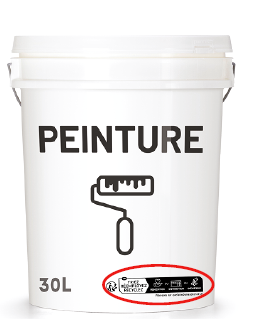
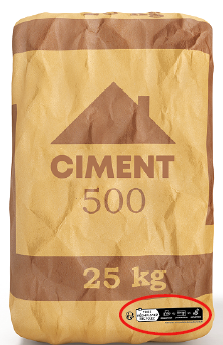
Product packaging: For this type of support, the use of the monochromatic black version is recommended.
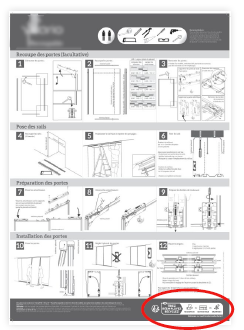
Instruction manual: On assembly instructions, the use of the monochromatic black version is recommended due to printing constraints for this type of support.
Usage Rules
Protection Area: It is defined relative to the size of the "FR" bubble. It delineates a space around the TRIMAN and the brand block where no graphic elements (text, lines, images) should appear.
Forbidden:
Changing the color of the TRIMAN. It must remain consistent with the brand block color.
Using the marking without the TRIMAN logo
Changing the placement of the TRIMAN
Changing the size of the TRIMAN
Modifying the proportions of the signage.
Colors and Typography: Several format and color variations allow you to adapt the sorting signage to your media.
Monochromatic black version: can be used in most printing situations.
White reserve version: If the marking is applied on a colored background, it must be used in white reserve.
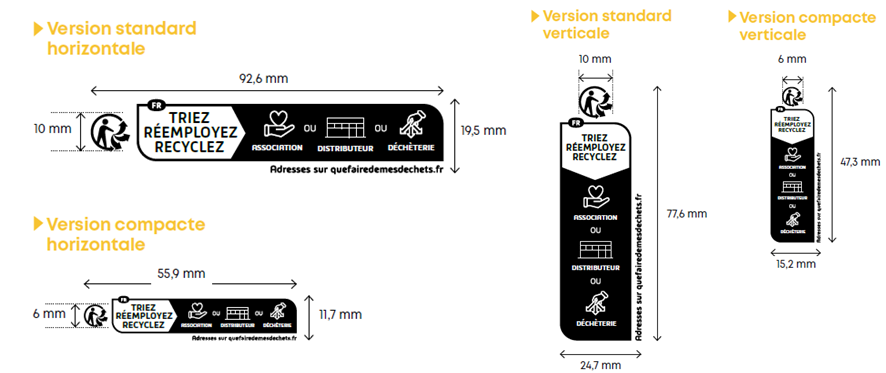
Dimensions : ADEME recommends minimum sizes for using the TRIMAN logo in the original usage guide for sorting signage: 10 mm in standard version; 6 mm for the compact version.
Standard version: Standard horizontal or vertical versions should be used preferentially.
Compact version: Compact horizontal or vertical versions should only be used when available space is restricted. These versions cannot be reduced.
In case of enlargement, the elements composing the signage (TRIMAN + Picto block + Web address) are inseparable and must be enlarged proportionally.
Marking by Product Category:
Building products and materials (PMCB) are divided into two categories, determining which TRIMAN logo must be used.
Category 1
Category 2
Products and inert materials composed mainly of minerals
Non-inert products and materials divided into 9 families


Concrete and mortar or components for their preparation (aggregate, sand, cement, additives...);
Lime;
Stones such as limestone, granite, sandstone, and lava;
Clayey or raw earth;
Slate;
Bituminous mix or components for preparing bituminous mix, excluding bituminous membranes;
Aggregate;
Ceramics;
Products and construction materials of mineral origin not listed in another family of this category.
Metals;
Wood;
Mortars, coatings, paints, varnishes, resins (decorative products);
Joineries, glass walls, and related products;
Plaster and related products;
Plastics;
Bitumen;
Mineral wools;
Products of animal or plant origin or other materials not listed in another family of this category.
The association between TRIMAN instructions and material categories is a recommendation.
It is entirely possible for a marketer in one category to display the instructions relevant to another category if deemed appropriate, especially to encourage material reuse.
Displaying the Signage:
Each TRIMAN signage must be accompanied by a clear message indicating the sorting instruction. Example: “To be deposited at a PMCB collection point”, “to be taken to a recycling center,” or "To be returned to the store/upon delivery."
📸 Example of TRIMAN visuals
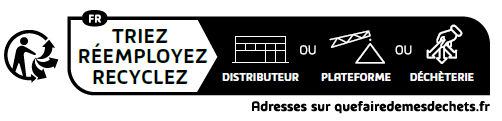
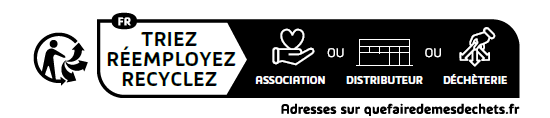
Explanation from left to right:
TRIMAN Logo:
This logo is mandatory and inseparable from the marking.
Human silhouette with a circular arrow symbolizing the sorting action.
Three arrows symbolizing sorting.
FR:
Country where the instruction applies.
Message: Here "Sort, Reuse, Recycle."
The message should direct consumers to the correct actions for discarding products: sorting
an essential prerequisite, reuse, and recycling.
Donations: to promote product durability.
Recycling towards zero waste.
Sorting Instructions: "Distributor or platform or recycling center."
You should present customers with three options that enable giving a second life to the used product, depending on its category.
Consumers should be made aware of solutions for giving a second life to used products.
Donating to social economy and solidarity organizations.
Deposit in textile containers, specific to curtains and blinds.
Return to the store or upon delivery, under certain size or sales conditions of the store.
Deposit at a recycling center.
Redirect to ADEME's website:
ADEME's search engine, dedicated to consumers, presents all sorting solutions and the location of collection points for each type of waste.
This mention is mandatory.
Updates and Evolutions:
Members must ensure that their signage and instructions remain compliant with regulatory developments and local sorting directives.
Responsibilities:
The marketer is responsible for compliance. Non-compliance can lead to sanctions.
Exceptions and Specific Conditions:
Exceptions concern the display of the TRIMAN logo and/or sorting information
If the surface of the largest side of a product or its packaging is between 10 and 20 cm², the sorting information can be dematerialized, but the display of TRIMAN remains mandatory.
If the surface of the largest side of a product or its packaging is less than 10 cm²: the display of TRIMAN signage and sorting information can be fullydematerialized. In this case, the information must be provided by other means, such as a website, a QR code accessible on the packaging, or other appropriate digital media.
Adaptation for Complex Shapes: For products or packaging with cylindrical or spherical shapes, where placement is difficult, the minimum required surface areas from 10 and 20 cm² are raised to 20 and 40 cm²; otherwise, dematerialization applies.
Case of an EPR product with packaging:
For an EPR product with packaging, it is possible to display a single TRIMAN logo if it is already present for the packaging, for example, and if the two pieces of information specifying the sorting instructions for the EPR product and packaging are juxtaposed.
Examples: a cardboard box containing parquet planks, a bag of mortar, etc.
Download TRIMAN building signage for your products and materials related to Buildings Category 1 (inert) and Category 2 (non-inert)
More information on the Official TRIMAN Usage Guide - OCAB.
📚 Important Details to Know
Regulatory References:
Articles L.541-9-3 and L.541-9-4 of the Environmental Code.
Decree No. 2014-1577 of December 23, 2014, relating to the TRIMAN signage and its updates.
Decree No. 2021-835 of June 29, 2021, relating to consumer information on sorting rules for waste from products subject to an EPR channel.
Graphical Features:
Monochromatic green or black pictogram on a white background, minimum size adapted to the surface.
Sorting instruction immediately associated with the pictogram.
Affected Products
Including any article that falls under the Extended Producer Responsibility (EPR) framework and is eligible for the TRIMAN system.
The TRIMAN Signage
Must not be accompanied by the recycling logo (Mobius Loop ♻️) alone, as this can be misleading.
⚠ Points of Vigilance
Regardless of the product size, the display of TRIMAN is mandatory with adapted dematerialization solutions for small or very large products.
Ensure that the instructions are neither misleading nor vague to avoid any confusion among consumers participating in selective collection.
Absence or error in display may result in:
Administrative penalties (fines),
Market refusal in certain cases,
Confusion for the consumer,
Risk of ineffective sorting and collection.
Regular regulatory updates require vigilance to ensure compliance with new standards.
Verify the conformity of the size and readability of the pictogram.
Digitized sorting instructions must be easily accessible via clear instructions.
Risks in Cases of Non-Compliance:
The absence of signage or misinformation can lead to administrative penalties stipulated in the Environmental Code (fines, compliance injunctions).
Forbidden:
Changing the color of TRIMAN. It must remain consistent with the brand block.
Using the marking without the TRIMAN logo.
Changing the placement of TRIMAN.
Changing the size of the TRIMAN figure.
Modifying the proportions of the signage.